Enju Ya
Enju Ya · Know Your Roots

Give your family a house that remembers.

The private family tree builder that keeps your stories, photos, and elder voices safe. Built for real, complex families. Start free, keep it forever.

Enju Ya means House of in Luhya and Luganda — the house your family lives in, and the one it remembers itself by.

Private by default. Zero ads. 100% your data rights.

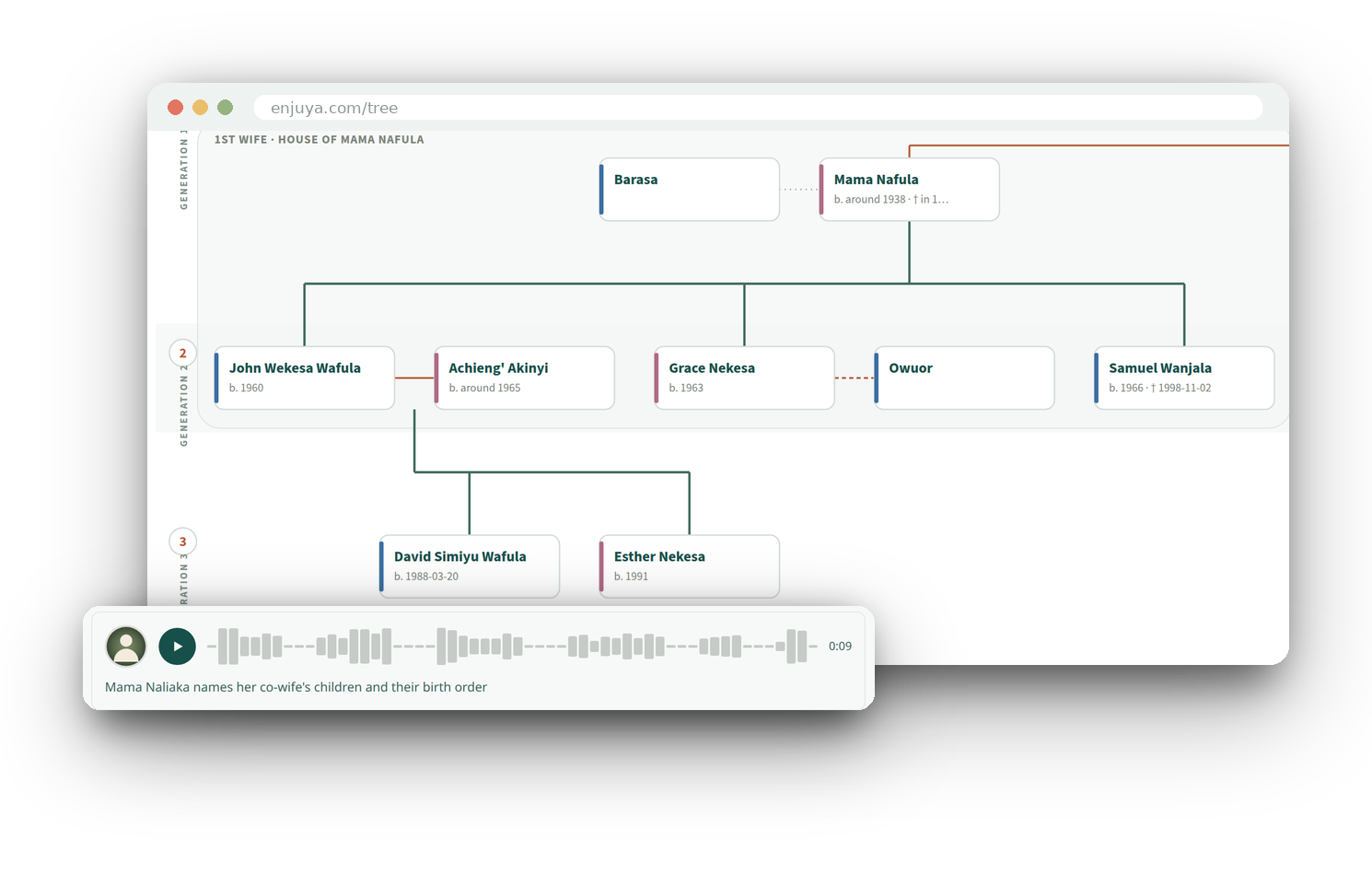
Enju Ya showing a family tree — a household with five children, one linked by a dashed adoptive line — and a recording of an elder with its waveform

There’s a question you keep meaning to ask.

Maybe it’s for your grandmother. What was her mother’s name? Where did the family live before? Why do we do that thing we do at weddings, and who started it?

You’ve been meaning to ask for years. There’s always time — until, one day, there isn’t.

There’s an old saying that when an elder dies, a whole library burns down. Anyone who has sat at a funeral hearing stories they’d never heard before — about a person they thought they knew — understands exactly what that means.

Enju Ya exists because of that feeling. The names of five generations shouldn’t live in one person’s memory. The photos shouldn’t sit in a shoebox no one can explain. Your children shouldn’t have to guess where they come from.

We built Enju Ya so the library never burns.
Family history doesn’t disappear all at once. It fades.

It fades one unanswered question at a time.

The old photos are still there, but no one’s left who can name the faces. The stories got told at gatherings, but nobody wrote them down. The family group chat holds a thousand precious photos — scrolling slowly out of reach, on phones that get lost, in accounts that get closed.

And the children grow up far from home — another city, another country — able to say what they do, but not who they’re from. Which side of the family. Which town they began in. Which grandmother’s stubbornness they inherited.

Here’s the uncomfortable truth: someone in your family is the keeper of the whole story right now, and nothing is written down. That’s the difference between your great-grandchildren knowing their story — and inventing one.

Enju Ya is where it all gets kept.

You start with what you know — even if it’s just your parents’ names. Enju Ya asks gentle questions, the way a good listener would: Your father’s parents — what were they called? Were there other marriages, other households? What year, roughly? Twenty minutes later, there’s a family tree in front of you that never existed anywhere before.

Then you invite the family. An aunt adds the branch you never knew. A cousin uploads the photo everyone thought was lost. Someone sits with your grandmother, presses record, and her voice — telling it her way — becomes part of the family record forever.

And when the family gathers — a wedding, a memorial, a reunion — you print the tree. A real one. The kind people stand in front of, pointing, saying there — that’s us.
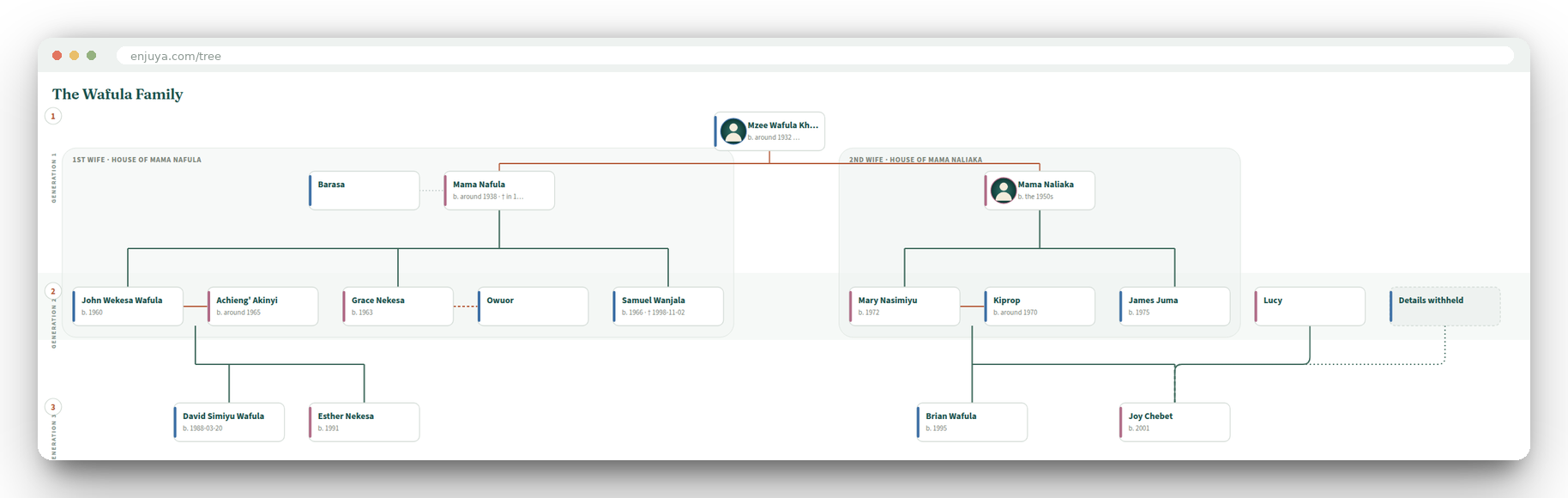
The Enju Ya family tree: three generations of the Wafula family across two households, with adoptive links marked by dashed lines and approximate dates such as “b. around 1932”
A real Enju Ya tree: two households, three generations, an adoption, a date nobody is sure of — and one relative whose details are deliberately withheld.

Built for real families. Including yours.

A tree that fits your family’s shape

Blended families and step-parents. A grandfather’s two households. An adoption. A name nobody’s sure of. Enju Ya holds your family the way it actually is — not as a neat diagram it isn’t.

“Around 1940” is a perfectly good answer

You don’t need certificates and exact dates. Enju Ya welcomes the way memory really works — about, roughly, sometime in the 60s — and you can sharpen the details whenever you learn more.

Your elders, in their own voices

Sit with your grandmother. Press record. Let her name her brothers and sisters and laugh in the middle of it. That recording stays with the family forever — attached to the very people she’s talking about.

Everyone builds it together

Invite family members by name — each invitation is personal, tied to their place in the tree. They add photos, fill gaps and correct details, while you stay in control of what changes.

Private. Genuinely private

Your family’s space belongs to your family. No public profiles. No strangers browsing your tree. Nothing is visible outside your family unless you deliberately share it — and even then, only what you choose, for as long as you choose.

Print it. Frame it. Hand it over

Turn your tree into a beautiful printed chart for the next gathering — the whole tree, one side of the family, or one grandmother’s house.

What your family gets back.

Answers, before the questions become impossible.The things you’ve always wondered, finally written down.
A tree that grows instead of fading.Every relative who joins makes it richer.
Belonging you can show, not just tell.Your children can see exactly where they fit — every branch, every house, both sides.
One safe place instead of a hundred scattered ones.Not a drawer, not a group chat, not one person’s memory.
A gift for people who haven’t been born yet.Someday, someone you’ll never meet will read what you kept, and know who they are.
How it works

Start small. Start today.

Step 1

Start with you

Answer a few friendly questions. Most people map fifteen to twenty relatives in their first sitting — more than they expected to know.

Step 2

Invite the family

Send personal invitations to the relatives who hold pieces of the story. Each person joins as themselves, right there in the tree.

Step 3

Gather everything

Photos, stories, dates, voices. The aunt who remembers everything finally has somewhere to put it all.

Step 4

Pass it down

Print the tree for the next gathering. Name someone to carry the archive after you. What you build in Enju Ya is built to outlive you — that’s the point.

What families say.

★★★★★
★★★★★
“I sat with my grandmother for one afternoon with Enju Ya open. By evening we had four generations — including two brothers nobody had ever mentioned to me.”
Wanjiru M., Nairobi
★★★★★
“My children were born far from where I grew up. Now when they ask where we come from, I don’t just tell them — I show them. Their names, on the tree, next to everyone who came before.”
Mei L., Singapore
★★★★★
“We printed the tree for my father’s memorial. People stood in front of it for an hour. Three relatives asked to join Enju Ya that same day.”
Sofía R., Madrid
★★★★★
“I always thought our story started when the family arrived here. Turns out it reaches back generations further than anyone had told me.”
Daniel K., Chicago

One price. One family.

You pay once for the whole family — not per relative, not per month. Everyone you invite is covered.

Starter Vault

Free

No card. No expiry. Keep it forever.

  • Up to 35 family members
  • The full tree builder — houses, adoptions, step-families and all
  • Photos at web resolution
  • 3 short audio memory clips
  • Printed family chart (carries a small Enju Ya mark)
Start free

Your data rights, guaranteed

Most platforms claim ownership of your data. We don’t. You retain 100% of the rights to your stories, images, and audio. We never sell your history.

You can export everything — the whole tree as a GEDCOM that opens in any genealogy tool, plus your photos and recordings — at any time, on any plan, with nothing stamped on it. Leaving is a button, not a conversation.

You might be thinking

“My family is complicated.”
Good — you’re exactly who we built this for. Blended families, step-parents, adoptions, half-siblings, a household with more than one marriage, relatives nobody talks about, gaps nobody can fill. Enju Ya was designed for complicated from day one. Simple families are the special case, not the other way around.
“I don’t know enough to start.”
You know more than you think — and “I don’t know” is an acceptable answer to every single question. Start with one name. The gaps aren’t failures; they’re invitations for the rest of the family to help.
“Isn’t it risky putting family information online?”
It would be, on a platform built to make things public. Enju Ya is built the opposite way: private isn’t a setting you enable — it’s the only way Enju Ya works. And your family’s information belongs to your family; you can take all of it with you, any time.
“What if I start and nobody else joins?”
Then you’ll still have done something remarkable: written down what only you know. Most families start with one determined person. The others come — usually right after the first printed tree shows up at a gathering.

Someone in your family still remembers.

The names. The village. The story behind the story. They would love to be asked — and future generations are counting on you to do the asking. You don’t need to know everything. You just need to start.

Twenty minutes today. Generations of thank-yous later.